Famous Headline 1: They laughed when I sat down at the piano, but when I started to play!”
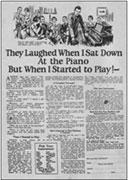 A headline is an ad within an ad. More than 80% of people would read the headline to decide if they should bother with the rest of the text and details.
This famous headline is voted by many copywriters as the best of the best. Adage, a marketing history reference resource said this headline is “arguably, the 20th century’s most successful” results-oriented mail-order copy.
And there’s an interesting story behind:
When John Caples started in first day of work at Ruthrauff & Ryan in 1925, his boss, Ev Grady, told Caples to start going through 2 large piles of ads. The first pile contained hundreds of winning display ads. The much larger second pile was a 7-inch binder filled with “losing” display ads. Grady reportedly told Caples to study both the successes, and the failures, so he can distinguish the good ads and the lousy ads. That way, he could learn how to write sales copy that sells.
Apparently, the engineer turned copywriter took every word to heart and studied very, very well. , 2 months later, Caples wrote what became one of the most famous headlines in history:
“They laughed when I sat down at the piano.
But when I started to play…”
What’s so great about this famous headline?
Emotion Hook:
Without reading the persuasive and convincing sales copy that follows, your sympathy and empathy are already with this budding pianist. Remember the ugly duckling story you read as a child? You like the “live happily after” ending when the ugly duckling blooms into a graceful swan. You believe there is a silver lining to a dark cloud. There is a part of you that yearn to see the underdog wins a fight whether it’s in a book, movie or real life. So, this headline has hooked you emotionally. And you’d want to know what happened when he started to play and what happened after he played. In other words, you will start reading the lengthy sales copy
Technical Hook:
The creative usage of negative and positive energies, before and after effects. When he just sat down, everybody dismissed him as a nobody by booing and laughing at him. You can see a hall full of rowdy crowds with squinting eyes and laughing mouth. You can hear the cackles and giggles, screaming and shrieking. You can sense the nervousness of the pianist wanting to prove his salt. You can see the bleak picture, you can feel the “before” effect.
The taunting silenced when he started to strum. The silence is golden. The silence is his complete triumph. Now you can see a hall of quiet people admiring his music with gasping mouths and attentive ears. You can hear the silence where the music reigns. You can sense that the audience is captivated. You know the underdog has got his bones, you are happy with the “after” results.
To know more about the goodness of this entire ad, please refer to Great Ad 12 which details how Caples pioneered a new hybrid of copy-writing that eventually got him a permanent seat at the Advertising Hall of Fame in 1973, while Adage placed him at #21 of Top 100 People of the Century.
Read Related post:
How To Write Headlines That Sell
Great Ad 12: They Laughed When I Sat Down
[tags]advertising headlines, John Caples[/tags]
13 Replies to “Famous Headline 1: They laughed when I sat down at the piano, but when I started to play!””
Hi Vivienne!
Its a great ad with a heart warming headline. It often brings in tears from my eyes. It’s that powerful. It identifies with everyone of us in every walk of life who tries to marvel his critics, his/her detractors and often his/her own devious selfdoubt.
The links are priceless for a thorough understanding of advertising to pour over the icons in advertising.
Thanks Vivienne!
Solomon
Wow! This looks like the start of a great series.
A fantastic article…
I spent months working on the Headline for my Accountancy brand…and they all laughed but when it started to play…they all shut up…
You’ve given given me so many laughs with this…
Hey, Vivienne! How are things going?
Just thought I’d chime in and say that I fully agree with you. This is by far the best headline ever made.
As a matter of fact, I’m thinking of using it in my next marketing campaign, provided that you’re allowed to do so.
If not, then I’ll just mix things up a bit. That usually works out :D
/Nabil, from Sweden.
Too bad the picture of this post isn’t working, but your story was great. I also had a few moments myself where people laughed at my ideas and then got it handed to them at the end.
Great stuff!
Kind Regards
Caspar from Tandvård Göteborg
Hi Nabil – Firstly I didn’t write the headline and Secondly, it is best not to model exactly word by word. Your idea of “mix thing up a bit” is usually best as you would want your marketing campaign to be infused with your own personality.
A great headline and it puts a whole story in the persons head for them to reference.
I got a book about John Caples headlines at Amazon.com to help me become a better copywriter for my sites. Just look up his name there, under books.
Mr Caples often said that you need to write using words that a 13yo could understand because that was the mental age of the average person. It’s a reminder to all of us that trying to be too clever & complicated with ad copy might make you feel good but it won’t sell anything!
Yes. That is the rule of thumb that copywriters should consider. Even Robert Kiyosaki uses simple layman English, without trade jargon, when delivering his finance & investment related seminar, because many people aren’t financially sophisticated enough. Thanks for visiting our blog and hope to see you gain.
If memory serves, the actual headline was “They laughed when I sat down at the piano, but then I started to play.”
They laughed when I disagreed with the facsimile headline. And rightfully so. Memory doesn’t serve very well.
Having a background in ad design and copywriting, I found this articlea a great reminder of the do’s and don’ts of ad creation. I memorized the headline many years ago in college and it continues to remind us everytime we sit down to create the perfect ad.